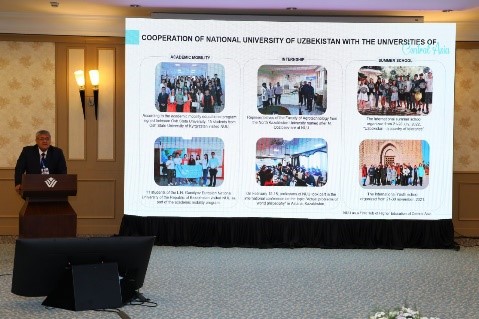
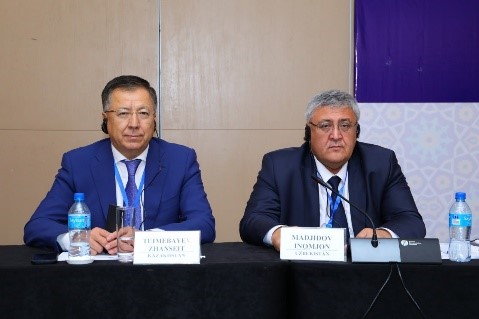
On July 7, the international conference “Central Asia as the next center of higher education” was held.
At this conference, the Minister of Higher Education, Science and Innovation of the Republic of Uzbekistan Ibrahim Abdurahmanov, the director of the head office of UNESCO in Tashkent, Sara Noshadi, the director of the regional office of UNESCO in Bangkok, Libing Wang, the head of the international evaluation office of the British Council, Victoria Clark, the Transnational Higher Education Christopher Hill, an international expert on the integration of education into the education system of the Middle East and Southeast Asian countries, representatives of QS and THE international rating agencies and rectors of higher education institutions in Uzbekistan participated.
During the conference, they are exchanging opinions on the fundamental new approaches of the higher education system in the era of globalization, the changes taking place in the national education system of Central Asian countries.
Negotiations are continuing intensively on the issue of increasing the quality of education and increasing the admission rate to higher education institutions as part of the reforms implemented in our republic in the following years.
Also, during the conference, it was emphasized the importance of developing science programs and courses that clearly reflect the UN Sustainable Development Goals.
Rector of the National University of Uzbekistan, Professor Inom Madjidov, gave a speech on the topic “UZBEKISTAN NATIONAL UNIVERSITY THE FIRST HUB IN CENTRAL ASIA HIGHER EDUCATION” and noted the following:
Today, the main task of universities is to increase the competitiveness of higher education. In this regard, integration, i.e. the activity of a center where education can be obtained in various fields, is of great importance in the creation of educational centers.
Prerequisites for the creation of an educational center are the expansion of university programs at the international level. This allows for the formation of mutually beneficial regional relations and integration into network universities