
Artificial Convection Experiment: A Practical Solution for Reducing Urban Dust Pollution
Advancing Sustainable Cities and Public Health
Air pollution is one of the most pressing environmental challenges facing modern cities. Fine particulate matter such as PM₂.₅ and PM₁₀ poses serious risks to human health, contributing to respiratory diseases, cardiovascular problems, and reduced quality of life. Addressing urban air pollution is therefore closely linked to the United Nations Sustainable Development Goals (SDGs), particularly those related to public health and sustainable urban environments.Scientists from the Hydrometeorological Scientific Research Institute (GMITI) conducted a field experiment at the institute’s Aranchi experimental research site to investigate mechanisms of dust resuspension and evaluate practical technologies for controlling airborne particulate matter in urban environments.
During the experiment, real-time measurements of PM₂.₅ and PM₁₀ concentrations were carried out under controlled natural conditions. Researchers tested three key technological approaches:
artificial convection using a vertical fan,
surface wetting to suppress dust,
and a vertical air channel designed to direct airflow upward.
The results provide valuable insights for improving air quality in urban areas, particularly in construction sites, industrial zones, road networks, and other dust-prone environments.
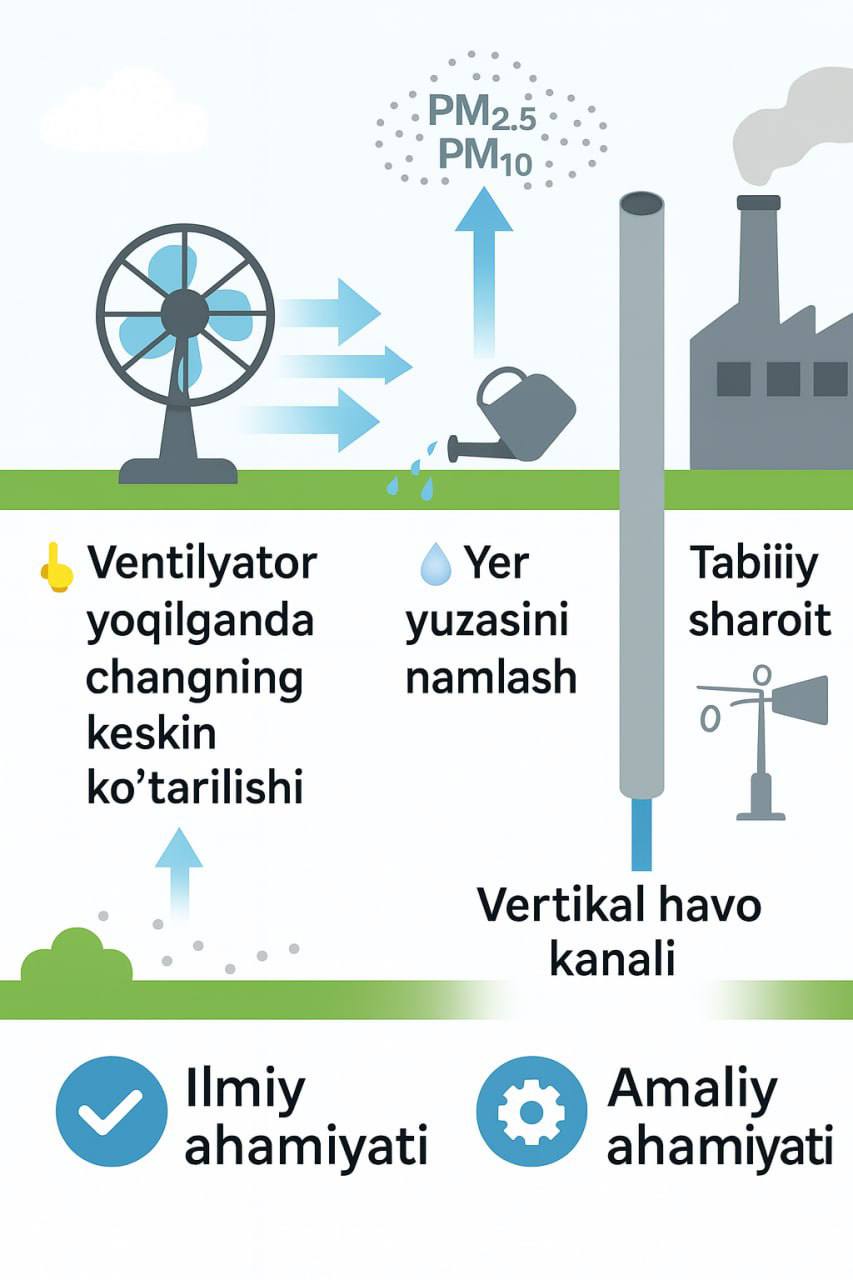
One of the most striking findings of the experiment was the rapid increase in particulate matter when the vertical fan was activated. Within seconds, PM concentrations increased by several orders of magnitude.
This phenomenon confirms the importance of resuspension, a process in which previously deposited dust particles are lifted back into the air by mechanical disturbance or airflow. In urban settings, such disturbances often occur due to traffic movement, construction activities, and industrial operations.
The experiment demonstrates that spikes in airborne dust levels are not always caused by new emissions; instead, they are frequently the result of previously settled particles being reintroduced into the atmosphere.
Among the tested approaches, surface wetting proved to be the most effective in reducing particulate concentrations. After a single wetting event, PM₂.₅ levels decreased from approximately 200 µg/m³ to 70–80 µg/m³, representing a reduction of nearly 2.5 times.
Moisture binds dust particles to the ground surface, preventing them from becoming airborne again. This finding suggests that regular wetting of urban streets, construction areas, and dusty surfaces can serve as a simple, low-cost, and efficient dust mitigation strategy.The Aranchi field experiment demonstrates that sudden increases in urban particulate matter are often driven not by new emissions but by resuspension of previously deposited dust. Controlling this process is therefore essential for effective air quality management.
The study shows that surface wetting and upward airflow control are among the fastest, most practical, and cost-effective solutions for reducing local dust pollution.
These findings provide a scientific foundation for developing new urban environmental management practices and improving air quality in rapidly growing cities worldwide.