

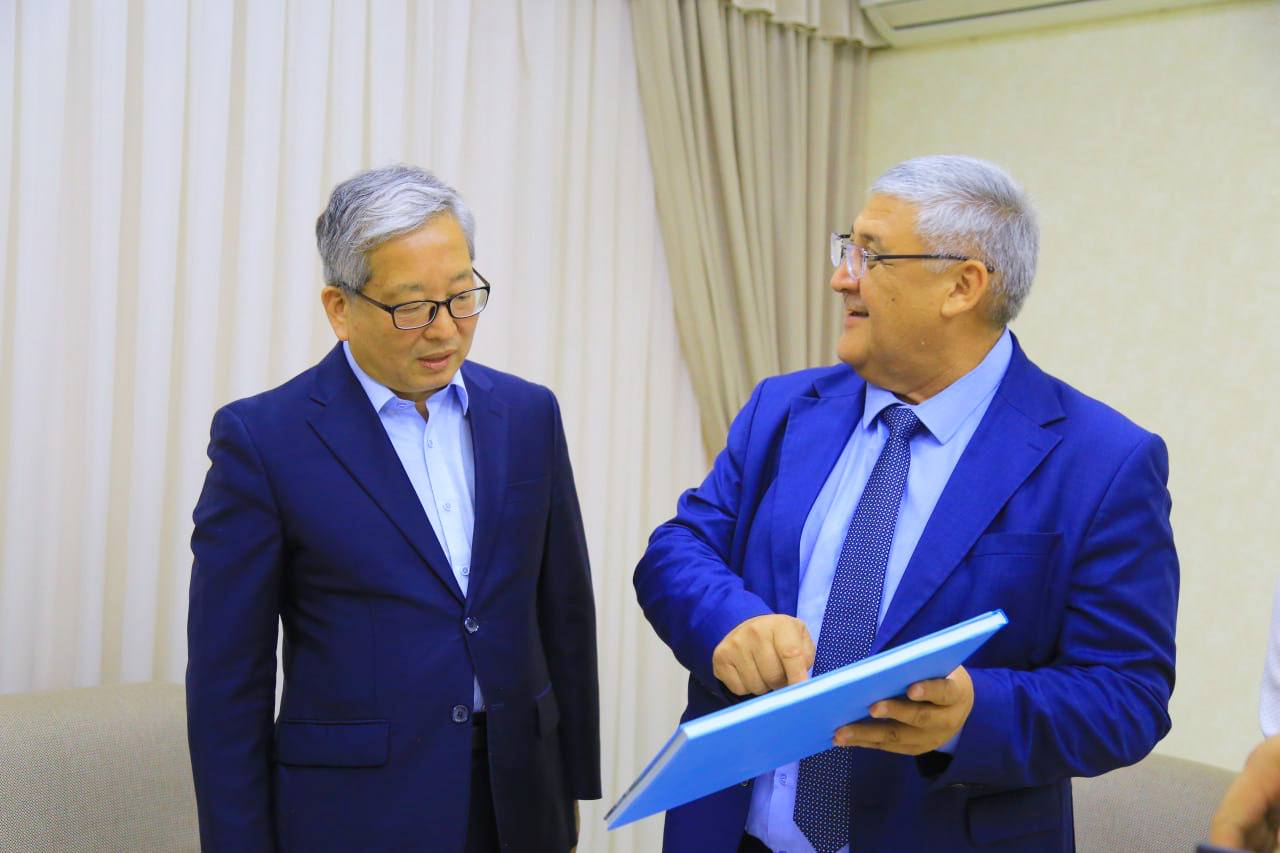


NUU has consistently demonstrated its commitment to expanding academic horizons through meaningful international cooperation. A recent meeting between NUU’s rector, Professor Inom Majidov, and a distinguished South Korean delegation has once again highlighted the university’s growing role as a hub for global research and innovation.
The delegation, which included leaders from the Hyundai Motor Chung Mong-Koo Foundation and scholars from Konkuk University, brought with them not only a spirit of friendship but also a clear vision for collaboration in fields that demand both intellectual rigor and practical application. Among these, the area of data collection and joint research stands out as a cornerstone for the future of this partnership.
Why does data matter so much in such collaborations? In today’s interconnected world, knowledge is not built on assumptions but on evidence that comes from systematic gathering, analysis, and sharing of data. Whether it concerns patterns of migration, models of social integration, or the effectiveness of educational programs, robust datasets allow researchers to move beyond theory into policy-relevant solutions. For Uzbekistan, where higher education is being rapidly modernized and aligned with global standards, such data-driven approaches are no longer optional; they are essential.
The potential collaboration between NUU and Konkuk University offers precisely this opportunity. By pooling expertise and resources, the two institutions can develop comparative studies that illuminate both similarities and differences between Uzbekistan and South Korea. Imagine a joint research project on migration: NUU’s scholars bring deep regional knowledge of Central Asia, while their Korean counterparts contribute insights from East Asia’s dynamic social landscape. Together, they build a shared dataset that can inform governments, NGOs, and international organizations.
Yet data collection is not only about numbers and surveys. It is also about methodology, ethics, and the creation of platforms where information can be exchanged securely and effectively. Here too, cooperation plays a vital role. South Korean partners can share advanced techniques and digital tools, while Uzbek scholars ensure that the data reflects local realities and cultural sensitivities. This mutual learning strengthens institutional capacity and prepares students and researchers alike to participate in globally relevant projects.
“For the National University of Uzbekistan, international cooperation is not only about academic exchange but about creating new knowledge together. Our partnership with South Korean colleagues, especially in the field of data collection and joint research, will allow us to address pressing issues with evidence-based solutions and contribute to the development of both our nations.”
Inom Madjidov, Rector of NUU
As the discussions evolve into formal agreements, one can expect to see new joint projects, shared databases, co-authored publications, and above all, a stronger academic bond between Uzbekistan and South Korea.