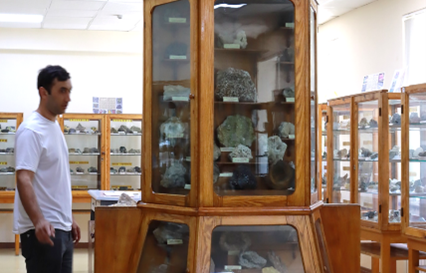
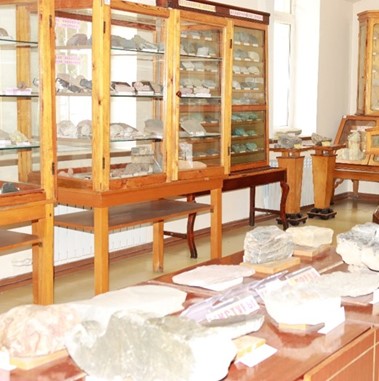
The Museum of Geology at the National University of Uzbekistan is a fascinating destination for anyone interested in Earth’s history and geological processes. Located in two spacious halls on the first floor of the university’s educational building, the museum is designed to be accessible to the public, welcoming visitors of all ages—from students and youth to the elderly.
The museum’s extensive collection includes around 3,200 fossilized specimens encompassing minerals, ores, stones, and examples of ancient flora and fauna. This impressive array offers insights into a wide range of geological phenomena.
Among its highlights is the department of petrography and lithology, which houses 537 samples of various rock types. This collection showcases:
Igneous Rocks: Both intrusive (formed from magma that cools and solidifies within the Earth’s crust) and volcanogenic (formed from volcanic activity).
Metamorphic Rocks: Altered by heat and pressure from their original form.
Sedimentary Rocks: Resulting from the accumulation and compaction of sediments, often revealing past environments such as ancient seas and riverbeds.
These rock samples illustrate significant geological processes, including:
Magmatic Activity: The formation and evolution of rocks through magma solidification.
Sedimentation: The deposition and formation of rocks in ancient sea and ocean basins.
Tectonic Activity: The uplifting and shifting of Earth’s crustal blocks, showcasing the dynamic nature of our planet.
In addition to the exhibits, the museum provides a room for scientific research and a space for lectures, educational films, and specialized online resources, enhancing its role as an educational hub.
Overall, the Museum of Geology offers a rich educational experience, highlighting Earth’s geological history and processes through its diverse and well-curated exhibits.